As one of two full-time people on Finland's national patient-safety reform, I mapped the fragmented current state, interviewing people across Finnish public healthcare and every patient-record vendor. I designed the future-state model, record an incident once and let it flow, and validated it over many rounds with the national data holders and the authorities who consume the data, while who should ultimately hold it was still unsettled. The deliverable was a national master plan and the architecture options beneath a 5–10-year reform that's still ahead, not a shipped system.
Context & Stakes
Finland has no single place to see the harm its own health system causes. The data exists, but it sits in a dozen separate registers, each built for its own purpose.
There is no national repository that lets anyone track, compare, and learn from patient-safety incidents across Finnish social and health care. Incident data is fragmented across many separate statutory registers, recorded inconsistently, and rarely current, so the country can't reliably see where harm is happening or whether anything is improving.
The reform plan estimates that correcting healthcare harm costs Finland around a billion euros a year; in 2024 alone, 25 million euros was paid out in patient-injury compensation, with the cost to providers many times higher. Up to roughly half of these events are thought to be preventable, and voluntary reporting systems typically capture only 5 to 20 percent of the harm that occurs. The mandate is clear: the WHO Global Patient Safety Action Plan makes incident-reporting uptake one of its top indicators, Finland's national patient-safety strategy puts reporting reform in 10 of its 12 objectives, and national audits and research had all already recommended a national system to monitor, compare, and learn. The Ministry of Social Affairs and Health gave the Finnish Centre for Client and Patient Safety the job of coordinating the reform.
Role & Approach
After I'd built a proof-of-concept on AI-assisted incident reporting inside a wellbeing services county, the Centre brought me onto the national reform. For most of it there were two of us working full-time: the programme director and me. I covered the systems and technical side.
My core job was to map the fragmented current state: every statutory way an incident gets recorded and reported in Finland, and every system and authority involved. In practice that meant interviews and meetings across Finnish public healthcare, plus every patient and client record-system vendor; I was the one on the project who could talk to vendors about how their systems work. In parallel I scoped possible collaborations and joint funding bids with public and private partners, one of which became a Sitra-funded pilot on surgical-complication reporting. I also owned the AI thread, keeping the reform current with a fast-moving field through meetings with AI companies, startups, and cloud providers.
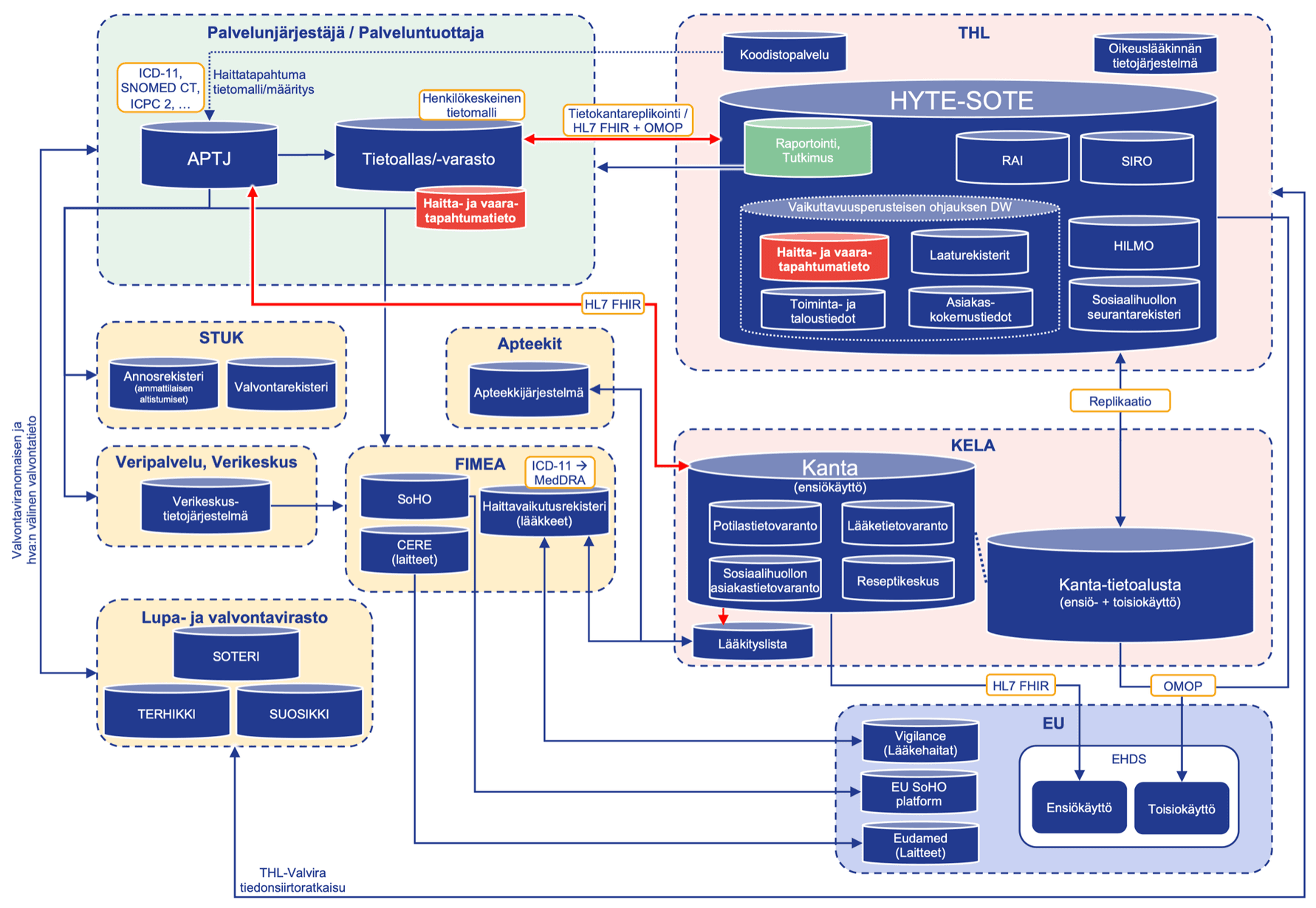
The rest of the work was designing the future-state vision and then validating it, round after round, with the national bodies that hold the data: the Finnish institute for health and welfare, the expected home for a future national repository, and the social-insurance institution, which runs the national Kanta data platform. How data ownership should work across them, where it should live, who holds it, how it moves, was still an open question, and much of the design was reconciling the options into something they could stand behind, along with the agencies (the medicines authority, the radiation-safety authority, and others) that consume incident data. It's strategic and systems design, and reading the architecture was part of it.
What I Found
The mapping turned up at least 10 distinct statutory recording and reporting procedures, each with its own law and its own receiving authority: ordinary patient-record entries, national care notifications, healthcare-associated infections, medically-related deaths, drug adverse effects, medical-device incidents, radiation-safety deviations, and more. Each was a separate pipe to a separate place.
Laid side by side, the pattern was clear. The same harm gets entered many times, in incompatible ways, into systems that never aggregate. Terminology drifts (the same event is called different things by different authorities), recording quality varies, and what one organisation learns from its incidents rarely reaches any other.
The same incident gets recorded over and over, in formats that don't match, and none of it reaches a place where it can be compared or learned from.
Problem Definition
Everyone wanted the reporting procedures reformed, but fixing them one at a time would still leave the same incident entered over and over. The task was to redesign the whole data lifecycle so an incident is recorded once and then flows, through shared structures, to the authorities and into one national repository that feeds learning back to providers.
Recording once is the spine of the target state. Today a single harm can be entered into the patient record, and a medicines-authority report, and a local voluntary system, separately, by hand, in mismatched terms. The future-state principle is to record it once where care already happens, in a nationally defined structure with standard classifications, and let it move from there. Transparency and national learning then come from the data flow itself, without another form to fill in.
Key Decisions
Three architecture options, two of them phases
Discarded: picking a single future architecture up front and asking everyone to commit to it. Cleaner to present, but unlikely to survive the first disagreement about data ownership.
Chosen: three target-state scenarios for how incident data could flow nationally, framed as alternatives with explicit tradeoffs, with the first two designed as sequential phases (start close to today's direct deliveries, evolve toward a single national channel as standardised transfer matures).
Tradeoff: more to align on and slower to a single answer. But it matched how national infrastructure changes, incrementally, and gave the data holders options to weigh.
International standards over a bespoke Finnish code set
Discarded: defining a quick, Finland-specific data model that could ship sooner.
Chosen: anchoring the future state on international classifications and a shared national data model, so incident data is interoperable and reusable without separate extractions, and so the model can extend across counties and report types instead of becoming another island.
Tradeoff: the standards it depends on are years from full adoption, which puts much of the roadmap on a timeline the project does not control. I treated that as a known dependency to design around.
AI added in stages
Discarded: positioning AI as the thing that fixes reporting now: identify the incident, classify it, file it, automatically.
Chosen: sequencing structures and data processes first, with AI's role growing as it can be slotted into recording, transfer, analysis, and reporting. The vision is AI-assisted, but staged.
Tradeoff: less exciting than "AI solves it," and the plan says why: full automation isn't possible yet, models misread complex cases, severity grading is still imperfect, and output quality has to be assured.
Solution & Deliverables
The core deliverable was a national master plan for reforming how patient-safety incident data is produced: the background and justification, the goals and scope, a full documented current state of every statutory recording and reporting channel, the target state on a 5–10-year horizon with its risks, and the follow-up work. Underneath it sat the design.
What I designed and assembled into it: a documented current-state model of the whole fragmented landscape; a single service-agnostic future reporting process (record once, structure with a shared data model, route through the national platform); three future-state architecture scenarios for how the data flows nationally; a concept for a national incident repository that aggregates the statutory data; the target-state change tables mapping today's fragmentation to a unified, AI-assisted future; and an AI-assisted reporting vision running through all of it. The plan also names its own next deliverable: the 5–10-year roadmap that turns this into a sequence of fundable steps.
Outcomes
A delivered national plan and the architecture beneath it
The master plan (version 1.0, December 2025) was completed as a Centre publication, carrying the current-state map, the record-once future process, the three architecture scenarios, and the AI vision. It's an end-to-end account, which didn't exist before, of how patient-safety incident data is produced in Finland and how it could be produced instead.
A foundation, with the reform still ahead
The reform itself is a 5–10-year programme that is still being planned. There is no shipped system, no adoption metric, and no measured drop in harm yet: most of the changes sit at "need identified" or "in progress," much of the roadmap depends on national standards and platforms maturing, and the plan wasn't yet public when I left it. What it did was set direction and build alignment, which in a system this fragmented is the part that has to come first.
Linked to a published proof-of-concept and a funded pilot
The reform grew directly out of the proof-of-concept I had built and validated earlier, which demonstrated technical feasibility, was published in a peer-reviewed journal, and seeded the Sitra-funded pilot whose funding bid I scoped during this engagement. The strategy and the working prototype reinforced each other.
Honest Reflection
Most of the work was alignment: pulling policy, process, and technology into one shared national vision, across ministries, national data holders still settling who owns what, the authorities who consume the data, and the vendors who build the systems. In a system this fragmented, people need a shared picture of how things work today before they can agree on a shared system, so the map and the vision were the core of the work.
The future state leans heavily on programmes I didn't control, international classifications and national platform development that are years out, so a real share of the roadmap is gated on other people's timelines. We also deliberately scoped out near-misses and no-harm events to keep the first reform tractable, even though they matter for prevention, and that's a real gap in coverage. The AI vision is staged on purpose.
Following both the policy and the architecture is what let me draw the future state and judge whether it could be built.